Track your biotech experience.
Help each other see risks sooner.
You're running your own experiment, and so are a lot of other people. We help you track it together, share what you find, and look out for each other along the way. Peptides, SARMs, prohormones, nootropics, GH secretagogues, and CRISPR-based therapies.
N of one, until N is all of us.
Spot each other, every cycle
Nobody benches heavy without a spotter. N-of-All is people tracking the same compounds the same way, so that when enough of them notice the same problem, it shows up for everyone taking it. The more people log, the sooner that happens.
Have my backHow it works
Three steps between what you log and a warning that has been checked.
Log what you're really on
Substances, doses, how you feel, your bloodwork — stored under a random ID, kept apart from your email, never your name.
You signal the crowd — without your name
Your entries pool with everyone else's under random IDs. Patterns nobody could see alone start to surface — which effects show up, how often, how soon — and only results from at least 10 people are ever shown.
A doctor reviews every alarm
Statistics can cry wolf, and hype spreads fast. So the algorithm only flags a pattern, and a physician reviews it before it reaches your screen. That review cuts out a lot of false alarms. It can't rule them all out, and it isn't medical advice about you.
You hear about it early, from both directions
Two things can raise a flag on something you are taking. The first is the people taking it with you: when enough of them report the same effect, and report it more often than everyone else does, that becomes a signal and it reaches you.
The second is the outside world — a regulator notice, a recall, a study worth knowing about. Both arrive in the same place, both say where they came from, and both are marked with how much weight they deserve.
A physician reviews both kinds before they reach you, and a community warning also needs at least ten separate people behind it. A warning here is a pattern, never one loud anecdote.
Start tracking — it's freeExample screen with sample data.
Example screen with sample data.
Your labs on one timeline
Type your results in, or photograph the printout and let the app read it. Each marker is charted against a reference range, and readings outside it are marked.
A slow drift that is hard to see between two appointments shows up as a line heading one way. For each compound, the app also lists the blood tests that published monitoring guidance usually includes, often starting with a baseline, because without one there is nothing to compare against.
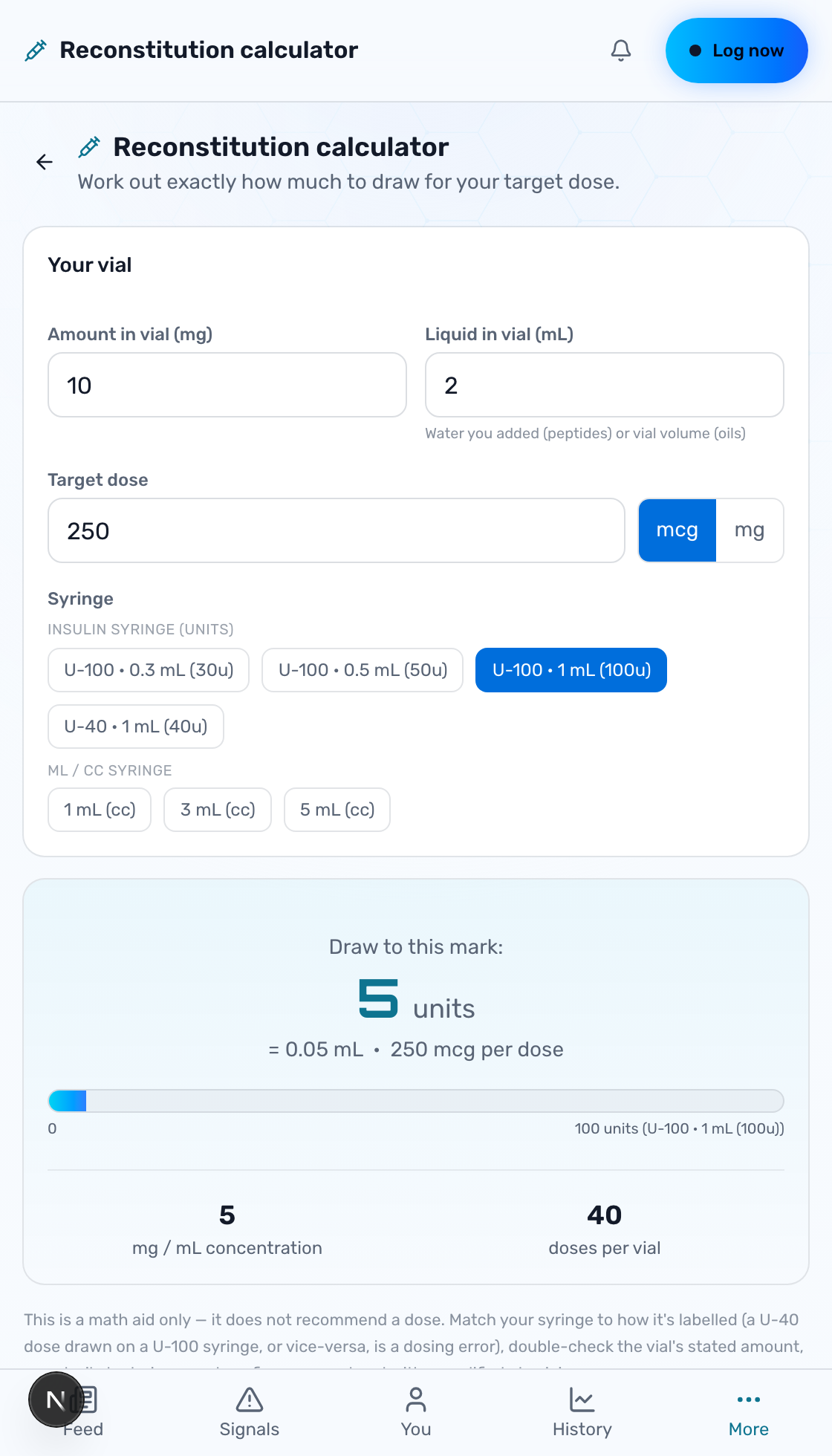
Getting the details right, not just writing them down
A lot of what goes wrong with these compounds is arithmetic, sterility and timing. A dose drawn on the wrong syringe. A vial reconstituted to a concentration nobody recalculated. Sites never rotated. Bloods never taken.
Those are the details these tools are built around. They do arithmetic, keep records and show what published sources report. They don't decide anything for you.
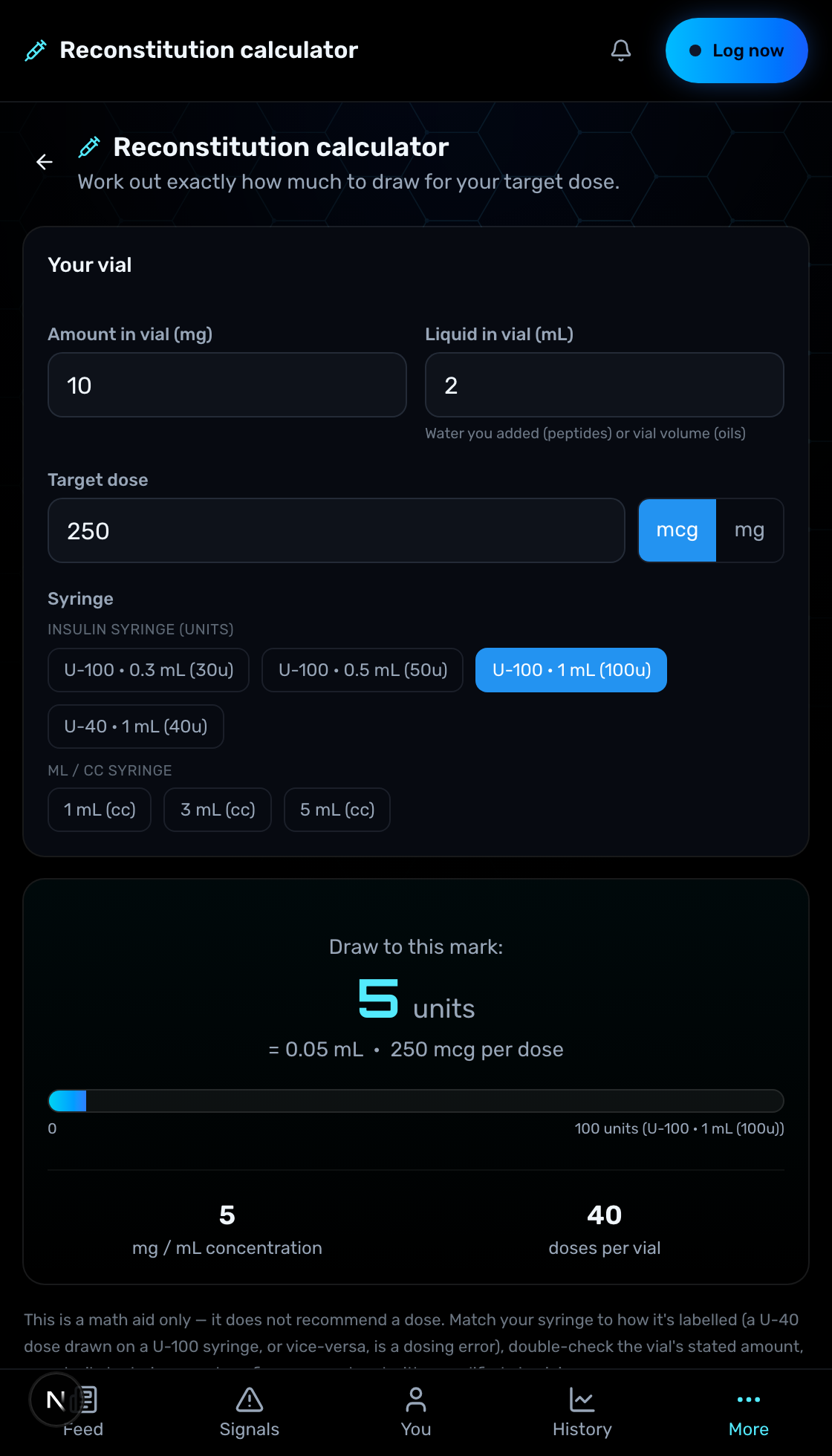
- Reconstitution calculator: mg in the vial and water added, turned into a concentration and a syringe volume for the dose you enter. It points out that U-40 and U-100 syringes are not interchangeable, because mixing them up is a common error.
- Stack planner: lay out your own plan in phases with a start date, and get reminders on the days it changes rather than every day. It also lets a report be filed against the right phase instead of just a date.
- Reported ranges by route: the same compound taken by mouth and by injection is not dosed the same way, and the app notes when an entry falls outside the range its sources report.
- Injection-site log: a simple map of where and when, so you can see which sites you used last.
- Blood tests by compound: the markers that published monitoring guidance lists for each compound, including when a baseline is usually taken.
None of this is a recommendation to take anything, and none of it replaces a doctor.
Why we built this
I'm a physician. Every day I make decisions from data — labs, guidelines, trials built up over decades. Then someone asks me about a peptide, a SARM, a gene therapy, and I have almost nothing to work from. These compounds live outside the research system, so the evidence that would let anyone reason about them honestly simply doesn't exist. No data, no way to decide.
N-of-All is my attempt to build that evidence — privately, together. People are going to use these substances whether or not anyone approves, and pretending otherwise has never kept a single person safe. Pooled, honest data might.
We will never tell you to take anything. We'll help you see what others have already reported.
One thing to be clear about
Everything you log is pooled — under a random ID, never your name — with everyone else's to build the safety data. That is not a setting you turn on; it is what this is. There is no version of N-of-All where you read what others reported and contribute nothing back, because that version has nothing in it to read.
You can delete your account whenever you want. What you already contributed stays in the pool, de-identified — other people's signals are built on it, and it can't be pulled back out without taking theirs apart too.
Why N-of-All?
In research, N stands for the number of people in a study. An N-of-1 trial focuses on one person, tracking their experience carefully over time to understand how they respond — the design clinicians fall back on when there is no population data to draw on.
When you take a compound, you may already be doing this: changing something and watching what happens. But memories fade, measurements vary, and patterns are easy to miss.
N-of-All helps you track your experience consistently — the same questions, the same measures, over time, starting from your own baseline.
Then we bring individual experiences together. One person's experience can't prove much on its own. But many people reporting the same way can reveal patterns worth exploring, which is why nothing here becomes a signal until at least ten separate people are behind it.
N of one, until N is all of us.
Questions
Is it anonymous?+
Not completely, and we'd rather tell you straight. Your health entries are stored under a random ID, separately from your email (and you don't have to give an email at all). They're linked only so you can see your own data, and our review tools show random IDs, not emails. Other members only ever see statistics built from at least 10 people. When you delete your data or your account, the link is cut: what stays in the shared data can't be connected back to you. Backup copies take a short while longer to expire.
Is it free?+
Yes — it's free while we're in beta.
Is this medical advice?+
No. Everything here is general, observational information. It describes what studies and other members have reported, and it doesn't tell you what to do. It isn't a substitute for a clinician who knows you.
What can I track?+
Peptides, SARMs, prohormones, anabolic steroids, GH secretagogues, nootropics, metabolic agents and gene therapies — 117 compounds documented so far, and growing.
Do you sell my data or run ads on it?+
Never. No data sale and no advertising — ever. We don't use analytics or ad trackers either.
Can I delete my data?+
Anytime. Download a full copy, or delete it in two steps. Your past side-effect reports stay in the shared safety data under a new random ID that can't be traced back to you, with your notes removed. That's what keeps everyone's statistics stable.